
Jack County Parole and Probation Compared
Texas divides release decisions, post-prison supervision, and court community supervision among separate authorities. The Texas Board of Pardons and Paroles decides parole and discretionary mandatory-supervision cases and sets conditions. The TDCJ Parole Division processes an approved state release and supervises the person afterward. A Jack County court can instead order probation without a parole release from prison.
| Record type | Who creates or manages it | What it can establish |
|---|---|---|
| Parole | Board of Pardons and Paroles and TDCJ Parole Division | Conditional release from state confinement and the conditions that follow |
| Mandatory supervision | BPP and TDCJ | A state release path governed by eligibility, review, and a release certificate |
| Probation or community supervision | Sentencing court and local CSCD | A court-ordered community sentence, not proof of a prison parole event |
| Final discharge | The authority administering the sentence | Completion of the sentence or supervision, which is later than physical release in many cases |
- Eligibility
- The point at which a case may be considered. It is not a promise of release.
- Release certificate
- The state document used in processing an approved parole or mandatory-supervision release.
- Absconder
- A person alleged by the supervising authority to have stopped complying or reporting.
- Discharge
- Completion of the sentence, including any parole, mandatory supervision, or community-supervision period.
Verify Jack County Post-Release Supervision
Begin with the custody history, because a Jack County Law Enforcement Center booking and a TDCJ commitment lead to different records. A missing name on the official Jack County jail roster says only that the person is not presently displayed. It does not show parole, probation, dismissal, transfer, or discharge.
- Check the criminal case for a probation order, judgment, sentence, or commitment. Felony records ordinarily route through the 271st District Clerk, while county-level misdemeanors route through the County Clerk.
- If the case led to TDCJ, use the TDCJ Inmate Information Search while the person remains in state custody. Read parole-review, location, and date labels exactly as shown.
- For a pending parole decision, use the BPP review-status line at 844-512-0461 with the TDCJ or SID number or exact date of birth.
- After a favorable vote, ask TDCJ Review and Release Processing at 512-406-5202 whether release has actually been scheduled or completed.
- For a known parole or mandatory-supervision case in Jack County, confirm the assigned office through the TDCJ county cross-reference and Wichita Falls District Parole Office.
A favorable vote code is evidence of a decision, not proof that the person passed through the release gate. Programming, conditions, an approved plan, records audit, or a release certificate may still stand between approval and departure. The Jack County projected release date guide explains why state date labels also must not be treated as actual release.
Jack County Parole Office Route
TDCJ assigns Jack County parole and mandatory-supervision cases to the Wichita Falls District Parole Office in Region V. This is a supervision and navigation point for a known state case, not a public database and not the office that verifies an ordinary bond release from the county jail.
Wichita Falls District Parole Office, Region V3100 Seymour Highway, Suite 118
Wichita Falls, TX 76301
Phone: 940-322-2721
Fax: 940-766-4216
Office staff may be limited in what they can disclose about an individual. Use the office to confirm routing or handle an established supervision matter, while using TDCJ records for state custody and the sentencing court for probation. Jack County’s website labels a department “271st Adult Probation,” but the research did not locate a current office page. An older state directory lists a Jacksboro office, yet its age makes direct verification necessary before relying on that contact.
How Jack County Parole Review Works
Texas does not hold a routine formal hearing for initial parole or mandatory-release consideration. The Board’s review process is a file review. TDCJ Parole Division generally identifies a case months before eligibility, an Institutional Parole Officer interviews the incarcerated person, notices go to the required officials and eligible victims or family, and a three-member panel votes in sequence.
Two matching votes settle the result; a split between the first two sends the decision to the third member. The written result may approve release with conditions or deny release and provide another review date. FI-1 means release when eligible, FI-2 names a future month and year, and some approval codes require a program before release. NR, SA, and DMS reflect different denial outcomes. None is an actual gate-out timestamp, and an approval can be withdrawn if new information arrives.
Jack County Supervision Conditions and Warrants
Conditions are set for the individual case and can govern reporting, residence, travel, treatment, programs, or other conduct. A violation allegation can begin a separate process. Revocation proceedings concern someone already released; they are not the same as the initial file-based parole review.
An absconder or parole warrant means the supervising authority alleges noncompliance and seeks a return to custody. It does not undo the historical fact that the person was released, nor does it prove a new offense. The TDCJ offender-information gateway links a Sex Offender Absconder Information Search, while the Jack County Sheriff Resources page routes users to the separate Texas DPS registry. Neither specialized tool is a complete list of parole absconders or a general supervision search. Confirm a warrant with the responsible authority.
Jack County Parole Release Notifications
The TDCJ Integrated Victim Services System covers people in TDCJ custody or on parole or mandatory supervision. It can provide confidential registration and status-change notices, including release-related events. It runs as a supplementary notification channel, not a certified release record.
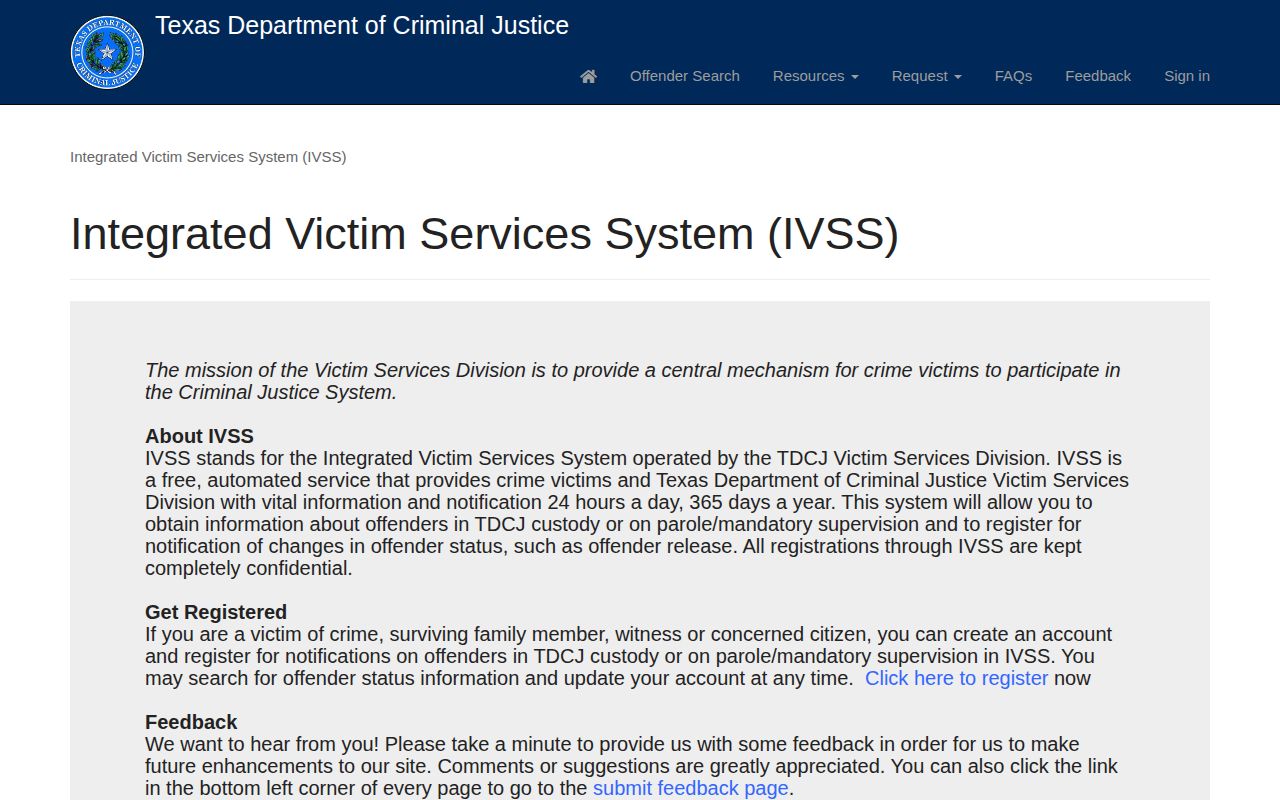
The TDCJ portal separates the state supervision route from ordinary Jack County jail releases. County custody notifications follow a different system because Texas moved county VINE registrations to Texas IVSS-Counties in 2025. A person released from the Jack County jail after bond, dismissal, or a county sentence is not thereby a TDCJ parole case. Use the Sheriff’s release record and court disposition for that event. When a notice says “released” or “out of custody,” preserve the agency and event time, then ask the originating custodian whether the event was community release, parole, transfer, or another movement.
Identification After a Jack County State Release
TDCJ’s Reentry Program reports that Phase I helps eligible people nearing state release obtain a replacement Social Security card, certified birth certificate, and state identification card. This service belongs to the state-custody process. It is not a service promised by the Jack County Law Enforcement Center, and eligibility should not be assumed from a county booking.
Release paperwork and identity records serve different purposes. A state identification card may help with daily needs, while the TDCJ release certificate and offender record document the legal custody path. Questions about disputed time calculations go to TDCJ Classification and Records, which provides a purpose-neutral correction route. Keeping those records separate prevents a practical reentry service from being mistaken for proof of final discharge.
Getting Home After Jack County Parole Release
The TDCJ Reentry Resource Guide lists Concerned Citizens/Public Transit Service at 400 East Pine Street in Jacksboro, 940-328-1391. It describes curb-to-curb transportation, lists a $2 fare for riders age 64 and younger and $1 for riders age 65 and older, and recommends calling a day ahead.
That listing is a practical local option, not a documented jail-release shuttle. It does not say a vehicle waits at the Jack County jail or Lindsey Unit. A person arranging travel after state release should first confirm the scheduled release location with TDCJ, because a person confined in Jack County may leave from an assigned unit or another state release site. Family should verify before traveling.
When Jack County Supervision Ends
Physical release, supervision, and final discharge are separate milestones. TDCJ defines discharge as completion of the sentence and release from incarceration, parole, mandatory supervision, or community supervision. A person released from prison to parole remains under the sentence until the later discharge event. Likewise, a probationer may never have been paroled from state prison at all.
To document the endpoint, ask the agency administering that sentence for its existing discharge or completion record. For a court probation case, use the sentencing court and CSCD record. For TDCJ parole or mandatory supervision, use TDCJ Classification and Records and the assigned parole channel. The site’s Jack County released inmate search and records guide explains how to pair these state records with a Sheriff release entry when county custody also appears in the history.
Public Record Search
Sponsored Results